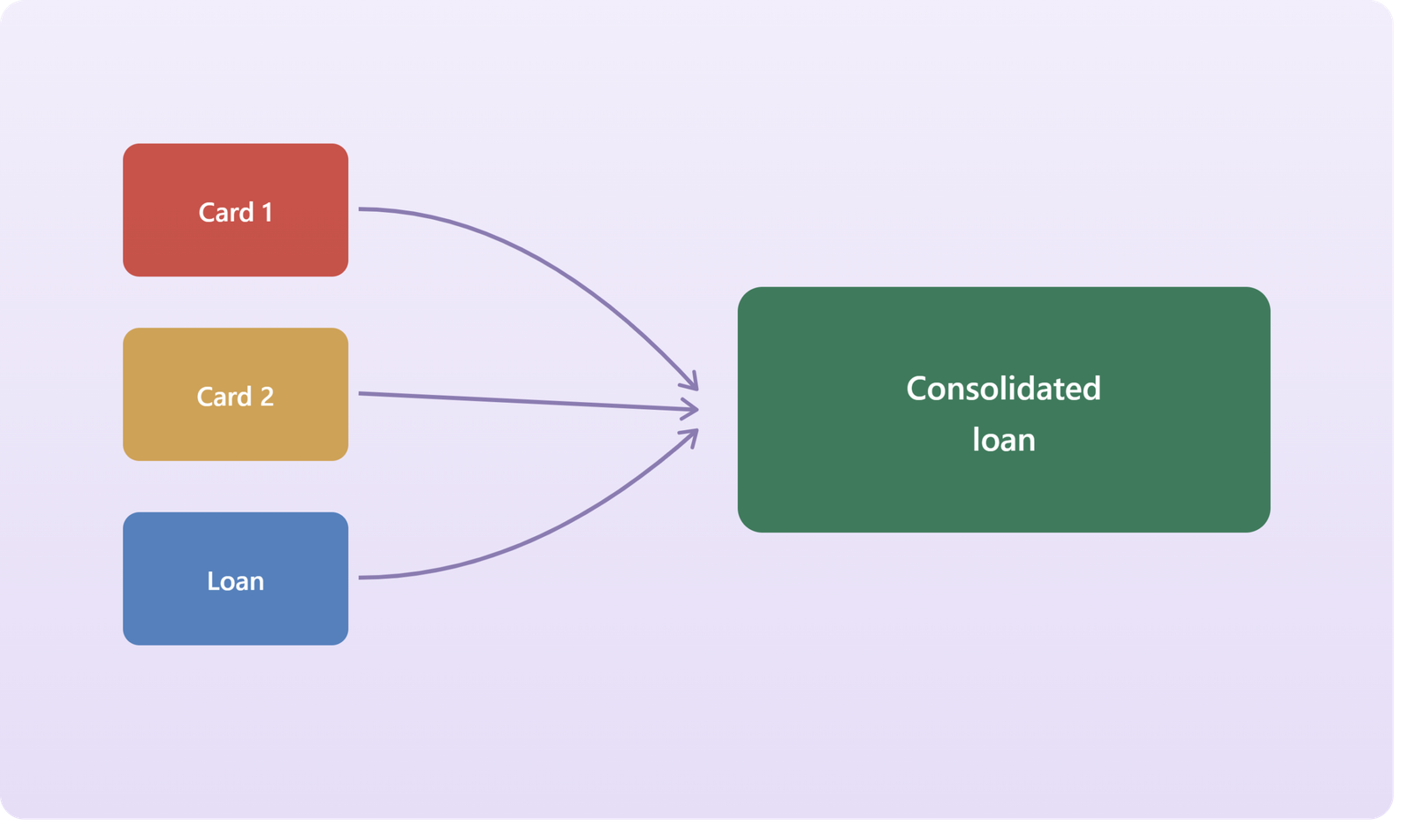
Carrying multiple debts with different interest rates, due dates, and minimum payments can make managing your finances feel like a full-time job. Debt consolidation loans are designed to simplify that — combining several debts into a single loan with one monthly payment. Done thoughtfully, consolidation can reduce interest costs and simplify your budget. Done without understanding the trade-offs, it can extend your debt timeline or add costs you didn’t anticipate.
This guide explains how debt consolidation loans work, what determines your rate, and how to evaluate whether consolidation makes sense for your specific financial picture.
What Is a Debt Consolidation Loan?
A debt consolidation loan is a personal loan (or in some cases, a home equity loan) used to pay off multiple existing debts — commonly credit card balances, medical bills, or other personal loans — leaving you with a single loan and a single monthly payment going forward.
The appeal is straightforward: instead of juggling several due dates and interest rates, you have one predictable payment. If the new loan carries a lower interest rate than your combined existing debts, you can also reduce the total interest paid over time.
How Debt Consolidation Loans Work
When you take out a consolidation loan, the lender typically disburses funds either directly to you or, in some cases, directly to your creditors to pay off the existing balances. From that point forward, you’re repaying a single lender under the new loan’s terms — a fixed interest rate, a set repayment term (often 2 to 7 years), and a defined monthly payment.
It’s worth noting that consolidation doesn’t erase debt — it restructures it. You still owe the same underlying amount (plus any new interest), just organized differently.
What Affects Your Debt Consolidation Loan Rate
Lenders price consolidation loans based on several factors, and no two borrowers see identical rates.
Credit score. This is typically the single largest factor. Borrowers with stronger credit histories generally qualify for lower interest rates, while those with weaker credit may see higher rates or need a co-signer.
Debt-to-income ratio. Lenders assess how much of your monthly income already goes toward debt payments to gauge your capacity to take on a new loan.
Loan amount and term. Larger loan amounts and longer repayment terms can affect the interest rate offered, and longer terms — while lowering the monthly payment — often mean more total interest paid over the life of the loan.
Secured vs. unsecured. Unsecured personal loans don’t require collateral but often carry higher rates than secured options like a home equity loan, which uses your home as collateral and carries the risk of foreclosure if you default.
Lender type. Banks, credit unions, and online lenders each have their own underwriting models, which is why rates can vary meaningfully between institutions for the same borrower profile.
Is Debt Consolidation a Good Idea for You?
Debt consolidation tends to make the most sense when a few conditions line up:
- You’re currently paying high interest rates on multiple debts, especially credit cards.
- Your credit profile qualifies you for a consolidation loan rate meaningfully lower than your current average rate.
- You have a clear plan to avoid running up new balances on the accounts you just paid off.
- You want the simplicity of a single fixed payment instead of managing several accounts.
It tends to make less sense if the new loan’s rate isn’t meaningfully better than what you’re already paying, if fees eat into the savings, or if there’s a real risk of accumulating new debt on the accounts freed up by consolidation.
Debt Consolidation Loans vs. Other Options
| Approach | How It Works | Best Suited For |
|---|---|---|
| Debt consolidation loan | Combines debts into one new loan with fixed terms | Borrowers with decent credit seeking a lower rate and simpler payment |
| Balance transfer credit card | Moves balances to a card with a promotional low or 0% APR period | Borrowers who can repay the balance before the promotional rate expires |
| Debt management plan | Credit counseling agency negotiates terms with creditors | Borrowers needing structured support and creditor negotiation |
| Debt settlement | Negotiating to pay less than the full balance owed | Borrowers in significant financial hardship, understanding credit impact risks |
Each path carries different costs, credit implications, and timelines, so the right choice depends on your credit profile, the size of your debt, and how much structure or support you need.
Costs and Fees to Watch For
Beyond the interest rate itself, a few costs can affect the real value of a consolidation loan:
- Origination fees — some lenders charge a percentage of the loan amount upfront, which reduces the funds you actually receive or adds to the balance.
- Prepayment penalties — less common with personal loans but worth confirming, especially if you plan to pay the loan off early.
- Late payment fees — standard across most loans, but worth knowing in advance.
- APR vs. interest rate — the APR reflects the interest rate plus most fees, giving a more complete picture of the loan’s true cost than the interest rate alone.
Comparing the APR — not just the advertised interest rate — across multiple lenders is one of the most reliable ways to identify which offer is genuinely more cost-effective.
Steps to Take Before Applying
- List out your current debts, including balances, interest rates, and minimum payments, so you can calculate your true combined interest cost.
- Check your credit score, since this heavily influences the rates you’ll be offered.
- Get prequalified quotes from multiple lenders where possible — many allow a soft credit check that doesn’t affect your score.
- Compare APRs, not just advertised rates, across every offer.
- Calculate the total cost of the new loan (monthly payment × number of months) versus what you’d pay continuing with your current debts.
- Have a plan for the freed-up credit, whether that means closing accounts, reducing limits, or simply committing to not adding new balances.
A Word on Timing and Discipline
One pattern worth being aware of: consolidation loans work best as part of a broader plan to change spending habits, not as a one-time fix. If the underlying spending pattern that created the original debt continues, there’s a real risk of ending up with both the consolidation loan and new balances on the accounts that were paid off — a scenario that leaves borrowers in a worse position than before consolidating.
Final Thoughts
Debt consolidation loans can be a genuinely useful tool for simplifying multiple debts and potentially lowering your overall interest cost, but the benefit depends entirely on your credit profile, the rate you qualify for, and the fees attached to the loan. Comparing APRs across multiple lenders, understanding the full cost over the loan’s term, and having a realistic plan for the accounts you’re paying off will determine whether consolidation actually improves your financial position.
8. FAQs
Will a debt consolidation loan hurt my credit score?
Applying typically triggers a hard credit inquiry, which can cause a small, temporary dip. Over time, consolidation can potentially help your score if it lowers your credit utilization and you make consistent, on-time payments.
What credit score do I need for a debt consolidation loan?
Requirements vary by lender, but generally, higher credit scores qualify for lower interest rates. Borrowers with lower scores may still qualify but often at higher rates or with a co-signer.
Can I consolidate credit card debt with a personal loan?
Yes, this is one of the most common uses of a debt consolidation loan — paying off multiple credit card balances with a single personal loan that typically carries a fixed rate and term.
Is debt consolidation the same as debt settlement?
No. Consolidation combines your existing debts into a new loan that you fully repay. Debt settlement involves negotiating to pay less than the full amount owed, which can carry more significant credit and tax implications.
How long do debt consolidation loans typically last?
Terms vary by lender, but personal loan terms commonly range from about 2 to 7 years, depending on the loan amount and the lender’s offerings.
Are there fees for debt consolidation loans?
Some lenders charge origination fees, and it’s important to review the full fee structure and compare APR — not just the interest rate — across lenders to understand the total cost.
Should I close credit cards after consolidating the balance?
This depends on your financial habits and credit utilization goals. Closing cards can reduce temptation to reaccumulate debt but may also affect your credit utilization ratio and average account age.
Is a debt consolidation loan better than a balance transfer card?
It depends on your situation. A balance transfer card can be cost-effective if you can repay the balance within the promotional period, while a consolidation loan may suit borrowers who need a longer, fixed repayment structure.